Complete site revamp
Information architecture and URL structure rebuilt around phone entities, models, generations, and their evaluation metrics, instead of scattered spec pages. Every phone got one clear, crawlable home.
 Muhammad Osama
A smartphone database competing on the exact names of the phones, some of the most competitive keywords in consumer tech. A complete site revamp, multilingual hreflang architecture, and server-side rendering of every evaluation metric into plain, cached HTML took it from 20 clicks a day to 350+, past 10,000 monthly clicks, without building a single backlink.
A database site lives or dies on its head terms. This one started at roughly 20 clicks a day while fighting for the exact names of the phones it documented.
The site was a smartphone database, the kind of property whose most valuable queries aren’t clever long-tail questions, but the direct names of the phones themselves. Those are some of the most competitive keywords in consumer tech, contested by manufacturer pages, retail giants, major tech publications, and video reviews, all with far deeper authority than a database site.
When this engagement started, the site earned around 20 clicks a day, and it was fighting on three fronts at once:
Six workstreams, executed together, each one aimed at making the site cheaper to crawl, unambiguous to parse, and impossible to confuse between languages.
Information architecture and URL structure rebuilt around phone entities, models, generations, and their evaluation metrics, instead of scattered spec pages. Every phone got one clear, crawlable home.
Reciprocal hreflang annotations, self-referencing canonicals, and consistent language targeting, so each language version consolidated its own signals instead of competing with the others.
Duplicated content appearing in other language versions was caught and reported in time, before it could depress rankings, keeping one authoritative version of every page per language.
All evaluation metrics for every phone are computed server-side and baked into the final page as plain, crawlable HTML. Nothing ranking-critical is left for client-side JavaScript to assemble.
The final plain-HTML pages are cached, so requests serve near-instantly. Super-fast loading that feeds directly into Core Web Vitals, for users and for crawlers.
Technical SEO handled continuously, as required: indexation, crawl budget, internal linking, structured data, and fixes shipped as issues surface. Not a one-time audit.
Growth came from architecture, rendering, and semantics, not from a link-building budget the site never had.
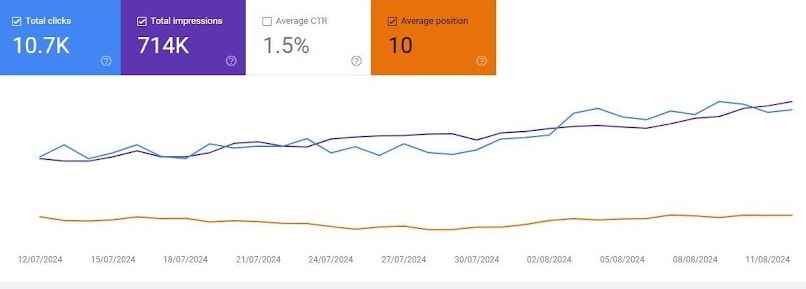
The trajectory is the compound effect of crawlers finally seeing complete, fast, plain-HTML pages, in every language, with duplicate signals cleaned up before they could do damage:
This is what the cost-of-retrieval pillar looks like in practice: when every crawl is cheap, every page is complete, and no signals are split across ambiguous language variants, a database site can take head terms from sites with vastly stronger backlink profiles, because the retrieval systems prefer the version that is easiest to parse and fastest to serve.
If ranking-critical content only exists after JavaScript runs, you’re asking the crawler to do unpaid work. Server-render the final page, ship it as plain HTML, and let nothing ranking-critical hide behind hydration.
Proper reciprocal hreflang turned the language versions from accidental competitors into one coordinated network. Timely reporting of duplicated content kept the consolidation intact.
Cached plain HTML made every crawl and every visit cheaper, for Google and for users. Fast delivery compounds into crawl frequency, indexation depth, and Core Web Vitals headroom.
350+ clicks a day from exact phone-name keywords with no backlink profile is what happens when a site is unambiguous to parse, complete in coverage, and trivially cheap to serve.